For school counselors
Directionality for School Counselors
Directionality is a short temperament assessment created by Dr. Michael Reece Carpenter, a counselor and educator with more than four decades of experience in schools, prevention and student assistance programs. It gives school counselors and students a shared, non-judgmental vocabulary — four color-coded communication pathways — for classroom guidance, counseling and peer programs.
How school counselors use Directionality
A few of the ways a school counselor can put the four pathways to work. None of them involves right or wrong answers — every pathway has strengths.
Counseling situations
A shared, non-judgmental vocabulary for how a student communicates and what they need, so a conversation can start from strengths.
Classroom guidance
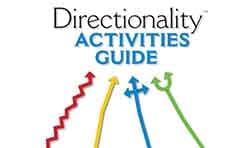
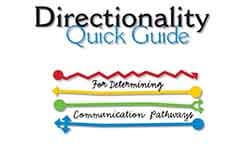
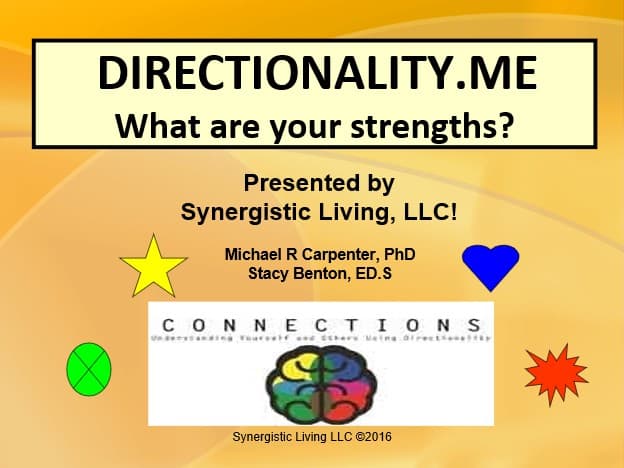
Run whole-class lessons with the Activity Guide, the Quick Guide and the PowerPoint presentation.
Peer helpers and peer mediators
Help student leaders recognize different communication styles, so they can listen and respond well during a conflict.
Parent conferences
Help parents see their own style and their child’s, and talk about what each of them needs.
Career exploration
Use a student’s pathways as a starting point for talking about strengths and interests. It starts a conversation; it is not a career-matching test.
Difficult situations
Name what is happening when styles clash, which can make power struggles and conflict easier to talk through.
Climate, Attitude and Relationships (CAR)
Directionality describes its goal as a healthy CAR: Climate, Attitude and Relationships. Just as a CAR needs four balanced wheels to run smoothly, a student, a class or a staff team works best when all four pathways are understood and valued.
In counseling, the picture is easy for students to hold on to. No wheel is better than another, and each one does a different job. A student who leans Red still uses Green, Yellow and Blue — and can learn when each one helps.
What students see in their results
- Their primary and secondary pathways — the two they lean on most
- A chart of their mix of all four colors
- What each pathway means
- Pathway Guides with strengths, needs and learning style
- A PDF they can download or print
Results describe preferences, not limits: everyone uses all four pathways. Each pathway has its own page — Red, Green, Yellow and Blue — and the color definitions compare them side by side. New to the approach? Start with What is Directionality?
Using Directionality with a group or caseload
Online codes. Order a code for each student. Codes come on handout sheets with simple steps and a QR code. You see the results of students who used your codes, grouped by class, with a spreadsheet download.
Printed sets. Use printed assessment sets of 50 with an Interpretation Set of 50 to work through results with an individual or a group.
Compare the options on Group Assessments, or see Directionality for schools and teachers for whole-school use.
Resources for classroom guidance
The Activity Guide (64 pages), Quick Guide (30 pages), Interpretation Set and PowerPoint (24+ slides) are made for lessons and small groups.
See all products and pricing.
Questions from school counselors
Who created Directionality?
Dr. Michael Reece Carpenter, a counselor and educator with more than four decades of experience in schools, prevention and student assistance programs. Read more about Directionality.Me.
Which ages is it for?
Elementary school students (ages 9–11), middle school students (ages 12–14), and high school students and adults.
Can I see my students’ results?
Yes, for assessments taken with your codes. You never see a student’s email address or any other results.
Is Directionality the same as Myers-Briggs?
No. Directionality is its own assessment. It draws on the same long tradition of temperament research as tools like the Myers-Briggs Type Indicator, but uses four color-coded communication pathways that are easy for children and adults to remember.
Can a student’s pathway change?
Directionality teaches that the core of who we are stays the same — but, just as a sculptor shapes marble, we can grow our communication style and strengths once we understand what we and others need.
Start with the assessment yourself
Take it online for $7 and see your own results first. Planning for a group or school? Call 470-789-2199 or send us a message.